

The 5 Best NYC Neighborhoods for Financial Services Office Space
It doesn’t matter what category of financial services your firm falls into.



Three blocks east of Grand Central, Midtown finally goes quiet. The crowds thin, the sidewalks open up, and you land in Turtle Bay, the corner of Midtown East that wraps around the United Nations, where consulates and international missions have kept their offices for decades. It’s never had the swagger of Park Avenue or the shine of Hudson Yards, and for the right tenant, that’s exactly the point.
Start with the rent, because that’s where the difference jumps out. Class A space near the U.N. asks around $43 a foot right now (Metro Manhattan, August 2025). Walk five minutes west to Grand Central and the same quality of building runs about $93. That gap isn’t a seasonal dip or a rounding error. It’s real, it’s held for a while, and it traces back to one thing: who leases here.
This isn’t a corridor of hedge funds and white-shoe firms outbidding each other for a trophy address. It’s diplomatic missions, nonprofits, and U.N. agencies that signed long leases years ago and have no reason to leave. Demand is steady, but it’s quiet, so nobody’s pushing the rent into the clouds. If your business runs on getting work done rather than being seen doing it, that quiet lands straight on your bottom line.
None of that makes it a slam dunk, and you should know the catches before the price tag wins you over. The subway is a genuine walk, since the 4, 5, and 6 run along Lexington several blocks west and there’s no train at all on First or Second Avenue. And because these tenants so rarely give space back, the bargain subleases you’d turn up in Columbus Circle simply aren’t on the table here. What you get instead is leverage, because vacancy in this pocket runs north of 22%, one of the softest Class A markets on the East Side, which means the landlord needs the deal more than you do.
Turtle Bay has always run on a different logic than the rest of Midtown East, and that logic is the whole case for leasing here. The trains are excellent and the subway is an afterthought. The address is world-famous and the rent is a bargain. The tenants are diplomats and nonprofits rather than banks and law firms. Put it together and you get the cheapest Class A in Midtown sitting on its calmest blocks.
The broader market gives you a tailwind on top of that. Manhattan just posted its strongest first quarter of leasing since 2014, with availability tightening for the eighth straight quarter (Colliers, Q1 2026), and Midtown Class A now asks around $85 a foot (Cushman & Wakefield, April 2026). Rents are firming and landlords are regaining their footing across most of the city. The UN area is the exception that works in your favor, because it doesn’t chase the headline deals, it absorbs the tenants who refuse to pay for them.
The rent is the whole reason you’re still reading, so start there. Class A space near the U.N. runs about $43 a foot (August 2025, Metro Manhattan), one of the lowest Class A figures anywhere in Midtown and less than half what Grand Central charges five minutes west. For an address on the United Nations’ doorstep, that’s a genuine bargain rather than a compromise.
The catch buried in that average is spread, because a single number is covering very different space. The river-view floors at 866 U.N. Plaza, the one true trophy building in the area, have asked in the low $70s to mid $90s, while the tired older stock on Second and Third and the side streets pulls the average down, especially with so much of it sitting empty. Realistically, you’re looking at somewhere between forty dollars for a plain older floor and ninety-plus for a wall of East River (Metro Manhattan internal research, June 2026). Pin down how much space you actually need before a view you can’t afford does it for you, and the Office Space Calculator will get you there in about a minute.
| Area | Class A Profile | Class B / C Coverage | Availability | Typical SF for New Leases | Tier |
|---|---|---|---|---|---|
| First Avenue / UN Plaza frontage | Prime Class A condo (866 UN Plaza), river and UN views | Limited | ~15 to 22% | 2,500 to 95,000+ SF (condo blocks) | Class A |
| Second Avenue corridor | Class A (800 Second Ave) | Deep Class B inventory | ~18 to 24% | 2,000 to 40,000 SF | Class A / B |
| Third Avenue / Grand Central edge | Class A with larger floor plates | Class B available | ~15 to 20% | 3,000 to 50,000+ SF | Class A / B |
| Dag Hammarskjold / East 40s side streets | Limited Class A | Class B and C dominate | ~20 to 25% | 1,500 to 25,000 SF | Value |
| Tudor City / 42nd Street edge | Little to no Class A | Class B and C, some loft | ~20 to 25% | 500 to 10,000 SF | Value |
| Submarket average (context) | $43.34 Class A direct | n/a | 22.2% | Varies | Value |
United Nations / Turtle Bay Class A direct asking rent ($43.34/SF) and vacancy (22.2%) are from Metro Manhattan, Class A Office Rents in New York City by Neighborhood (as of August 1, 2025). Area-level profiles, Class B and C coverage descriptors, and availability ranges are Metro Manhattan internal research (June 2026); the major brokerages publish Midtown submarket figures but do not break out per-area United Nations numbers. Rents are asking rents and do not reflect concessions.
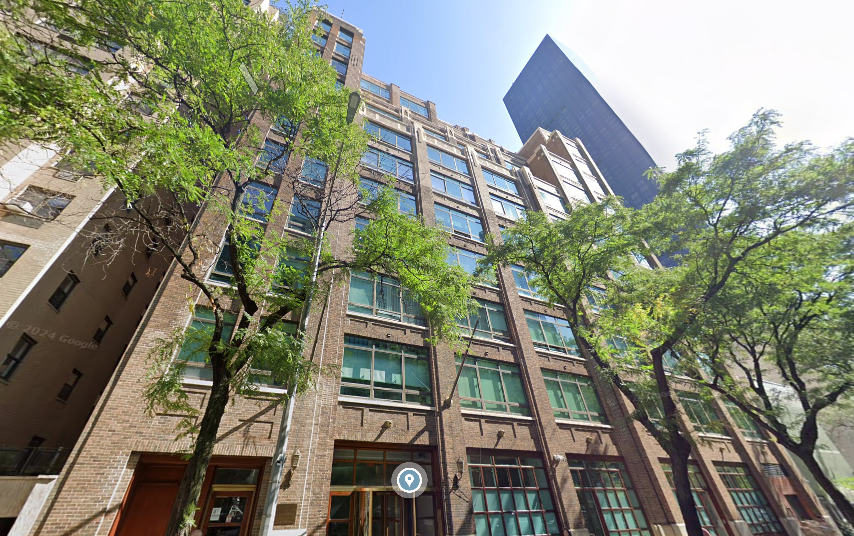
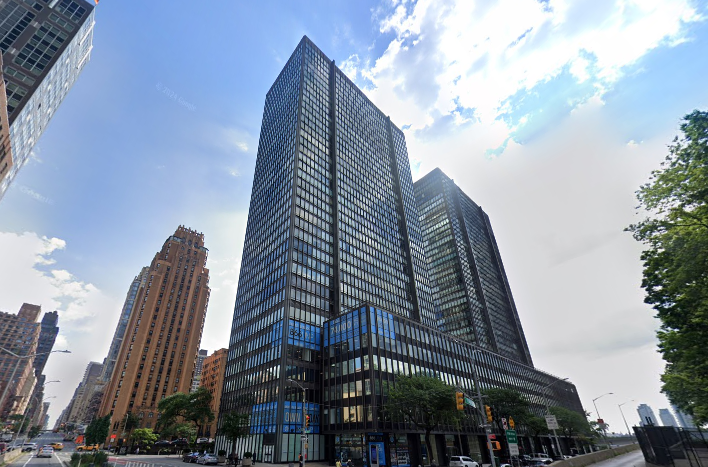
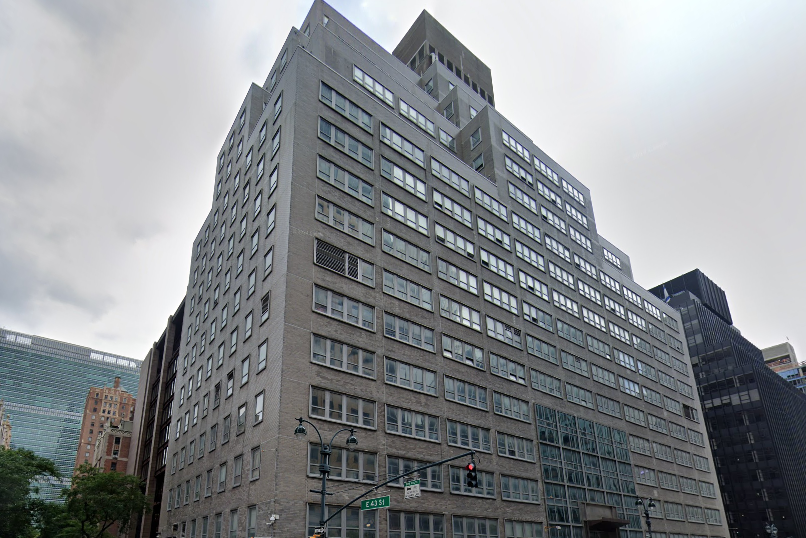
Class A in this submarket comes down to a single building, 866 United Nations Plaza. It’s thirty-eight stories and roughly 470,000 square feet, built in 1965 and gut-renovated in 2015, and it’s the only office tower east of First Avenue that isn’t the U.N. itself. The building earns its keep with a rooftop lounge, an on-site food hall, parking that feeds straight onto the FDR, and 360-degree views of the campus, the river, and the Chrysler crown. Because it’s a condo, a mission or nonprofit can own its floor rather than lease it. The view floors have asked in the $70s to $90s, and the tenant roster explains the premium: the consulates of Chile and Finland, Citibank, the U.S. State Department, and the permanent missions of Vietnam and the DRC.
Beyond 866, don’t expect to find new Class A, because there’s nowhere left to build it. The land is either the U.N.’s or already covered in prewar and postwar stock. If your business needs 27-foot ceilings and a $300 address, that’s a Grand Central or Park Avenue conversation, the kind of market where Nscale just paid a record $320 a foot at One Vanderbilt (CoStar via CompStak, January 2026). In the UN area, Class A means a well-run older building with a spectacular view and an international zip code. If the true trophy tier is what you’re after, the guide to how trophy buildings set themselves apart and the top Class A buildings in Midtown rundown will point you in the right direction.
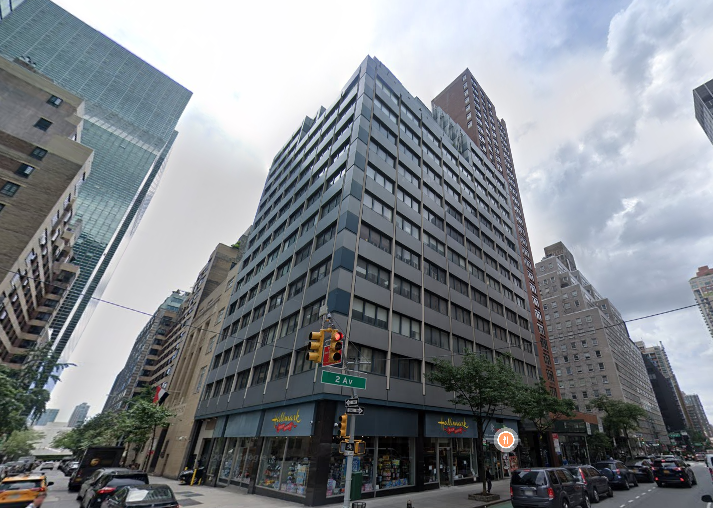
Most deals in the UN area close in Class B, along Second and Third Avenue and the side streets between them. 800 Second Avenue is eighteen stories that outperform their class on the better floors, home to the Consulate General of Israel, Surgicare of Manhattan, and a stack of medical tenants. 820 Second Avenue, the Diplomat Center, leans fully into its name, housing the missions of Croatia, Peru, and Barbados alongside Northwell Health, the United Synagogue of Conservative Judaism, and Hallmark. A block west, the Third Avenue towers trade some of that character for bigger, more efficient floors and Grand Central access without the Grand Central price.
What you’ll pay in Class B depends almost entirely on the building and the block (Metro Manhattan internal research, June 2026). Two buildings on the same street can quote wildly different numbers on the same afternoon, depending on how much space they’re carrying and how they read your credit, so walk the floors and treat the “average” with suspicion. This is solid ground for law firms, financial firms, and especially medical practices, since the Second Avenue buildings have leased to doctors and diplomats side by side for forty years.
The deepest discounts sit in Tudor City, on the East 40s side streets, and in the un-renovated boutique buildings around Dag Hammarskjold Plaza. 305 East 47th Street, also known as 3 Dag Hammarskjold Plaza, is the template: a Class B building leasing to the American University of Beirut, the Organization of African Unity, and the U.A.E. mission. This tier suits small missions, startups, nonprofits, arts groups, and back-office teams that want the U.N. address and the FDR on-ramp without the Class A invoice.
Two things are worth knowing before you sign at this level. First, your best deal won’t be a sublease, because there are essentially none (Metro Manhattan, August 2025); it’ll be a direct lease in an older building with a landlord who has real space to fill. Second, nobody publishes a clean Class C figure for these blocks, so a single flat number quoted at you deserves a hard look (that tier read is Metro Manhattan internal research, June 2026). The guide to what makes a building Class A, B, or C is worth five minutes before you start comparing.
The most expensive mistake tenants make in this market is fighting the wrong battle. They’ll spend three weeks grinding a landlord down two dollars a foot on the asking rent, feel good about the win, and then wave through the two terms that actually move the numbers: free rent and the build-out allowance. That’s where the real money lives, and in the UN area, with vacancy over 22% (Metro Manhattan, August 2025) and landlords who need to fill space, you have more room to push on both than almost anywhere in Midtown, particularly along Second Avenue and the side streets.
The ranges below reflect recent deals on a 5 or 10-year term (Metro Manhattan internal research, June 2026); shorter terms get less, longer terms get more. If you’re weighing how long to commit, the rundown on 3-year, 5-year, or 10-year lease terms lays out the tradeoffs.
| Building class | Free rent (typical) | TI allowance (typical) | Notes |
|---|---|---|---|
| Prime Class A (866 UN Plaza, view floors) | 8 to 12 months free | $80 to $120/SF | Concessions are tightest here, because there's only one building at this level and the owners know it. |
| Standard Class A (800 Second Avenue, Third Avenue) | 12 to 16 months free | $70 to $110/SF | This is the sweet spot, a real Midtown East address with genuine give on terms. |
| Class B (Second Avenue, Dag Hammarskjold, side streets) | 14 to 20 months free | $50 to $85/SF | High vacancy plus a 10-year commitment hands you serious leverage, and prebuilt suites are common. |
| Class C and value (Tudor City, older boutique stock) | 12 to 18 months free | $35 to $65/SF | Often as turnkey suites you can occupy within a month. |
The ranges below reflect recent deals on a 5 or 10-year term (Metro Manhattan internal research, June 2026); shorter terms get less, longer terms get more. Concession ranges vary materially by landlord, tenant credit, lease term, and building.
Two points before you sign. Once you stack the free rent and the build-out money, your effective rent, the figure that actually matters, drops well below the number on the door (the concessions breakdown runs that math). And a build-out allowance is only as good as what it actually builds, so understand who pays for the build-out before you sit down to negotiate.
This neighborhood is organized around institutions rather than industries. The marquee space near the campus goes to missions and consulates, and the buildings around them fill with international nonprofits, foundations, and U.N. agencies. Everything else, professional services, medical, finance, and back office, gravitates to the older Second and Third Avenue stock for the Grand Central access and the low rent. In practice, the building tells you the tenant, so finding your row below narrows the search quickly.
| Industry | Best-Fit Areas | Class Fit | Example Buildings |
|---|---|---|---|
| Diplomatic Missions / Consulates | First Avenue / UN Plaza, Second Avenue | Class A / B | 866 UN Plaza, 800 Second Ave, 820 Second Ave |
| International NGOs / Nonprofits / Foundations | UN Plaza, Second Avenue, side streets | Class A / B | 866 UN Plaza, 777 UN Plaza (Church Center), 305 East 47th |
| UN Agencies / Programmes | UN campus, First Avenue | Institutional | 1 and 2 UN Plaza (DC-1, DC-2), 3 UN Plaza (UNICEF), 807 UN Plaza (UNITAR) |
| Professional Services / Consulting | Third Avenue, Grand Central edge | Class A / B | Third Avenue towers, 800 Second Ave |
| Law Firms (international and boutique) | UN Plaza, Third Avenue | Class A / B | 866 UN Plaza, Third Avenue stock |
| Financial Services / International Banking | UN Plaza, Second and Third Avenue | Class A / B | 866 UN Plaza (Citibank), 820 Second Ave (Bank of America nearby) |
| Healthcare / Medical Offices | Second Avenue, side streets | Class B / C | 800 Second Ave (Surgicare, NY Medicine Doctors), 820 Second Ave (Northwell) |
| Startups / Small Business / Back Office | Third Avenue, Tudor City, side streets | Class B / C | Tudor City-area stock, 305 East 47th, value side streets |
Industry and class fits are Metro Manhattan internal research (June 2026). Vertical landing pages: Financial Services, Law Firm Offices, Startup & Tech Space, Medical Offices, Retail/Stores, Sublet Space.
If you’re running a small team or a nonprofit watching every dollar, this is one of the few genuinely prestigious addresses in Manhattan you can actually afford, because the low Class A rent and the deep bench of value stock carry the weight. To see how it compares with other neighborhoods, the 5 top neighborhoods for small businesses guide runs the comparison, and if you’re graduating from a coworking desk, scaling from coworking to your own office maps the jump. One honest caveat: if what you really want is exposed brick, timber, and a startup-loft feel, this isn’t the place. That’s a Midtown South conversation, so look at Chelsea or SoHo instead.
The UN area is quiet, and that quiet is a feature rather than a flaw. There’s no Grand Central food hall and no Columbus Circle mall. What the neighborhood offers instead is the river, the small waterfall at Greenacre Park, Tudor City Greens, and an address that registers with international clients. Amenities vary building to building, and the money here has gone into lobbies, elevators, and the floors themselves rather than flashy retail. Three tiers are worth knowing:
Prime Class A (866 United Nations Plaza): a rooftop terrace and lounge, an on-site food hall and cafe, renovated building systems, parking straight onto the FDR, and 360-degree views of the campus, the river, and the Chrysler Building. It’s the top of the submarket and the only building that competes on amenities.
Standard Class A and better Class B (800 Second Avenue, the Third Avenue towers): attended lobbies, modern elevators and HVAC, efficient floors, ground-floor retail and food, and a short walk to Grand Central. Increasingly, these come as built-out spec suites you can move into quickly.
Class B and value (820 Second Avenue, Dag Hammarskjold, Tudor City): prewar and postwar bones, good light, attended entrances, and rents that leave enough in the budget for the build-out you actually want. Quiet, institutional, and dependable.
Browse every Midtown building or filter active listings by size and price.
Ownership in the UN area is unusually fragmented, and it pays to understand it before you tour. The trophy building, 866 UN Plaza, is a condo, so its floors belong to a scattered mix of missions, nonprofits, corporations, and investors rather than a single landlord, and an AllianceBernstein affiliate picked up 29 units from Carlyle in 2025 (Bisnow). The Chrysler Building sits on land owned by Cooper Union, which is placing a new operator after evicting RFR. And the Second and Third Avenue stock splits between institutional Midtown East owners and long-tenured private families. A good broker already knows which of them fund build-outs and which dig in, and the rundown on the biggest commercial real estate landlords in NYC fills in the background.
| Landlord | Notable UN-Area Properties | Approx. Portfolio | Typical Lease Profile |
|---|---|---|---|
| 866 UN Plaza (office condo; AllianceBernstein affiliate holds 29 units, formerly Carlyle Group) | 866 United Nations Plaza | ~470K SF building, condo structure | Owned or leased floors, missions / nonprofits / corporates |
| Cooper Union (ground owner) | Land under the Chrysler Building (405 Lexington) | 1.2M SF tower on leased land | Ground lessor; new operator being placed (GFP in talks, 2026) |
| SL Green Realty | Third Avenue holdings near the Grand Central edge (e.g., 711 and 750 Third) | Part of SL Green's ~25M+ SF (NYC's largest office landlord) | Class A / B, 5,000+ SF |
| Cohen Brothers Realty | 805 Third Avenue, 622 Third Avenue, 750 Lexington (Midtown East edge) | Part of a large private Midtown portfolio | Class A, 5,000+ SF |
| Fisher Brothers | 605 Third Avenue (western edge) | Part of a large Midtown portfolio | Class A, 10,000+ SF, large floors |
| Missions, consulates, and nonprofits (owner-occupiers) | Owned condo floors at 866 UN Plaza and small buildings across Turtle Bay | Fragmented | Owner-occupied, long horizon, tax-exempt where eligible |
Portfolio figures are approximate. Several landlords listed (SL Green, Cohen Brothers, Fisher Brothers) hold much larger portfolios across Midtown, Midtown South, and Downtown. Building-level ownership on Second and Third Avenue is mixed and changes hands; confirm current ownership before an offer. The 866 UN Plaza condo transfer and Chrysler Building ground-lease status source to Bisnow and Commercial Observer (2025 to 2026); all other entries are Metro Manhattan internal research (June 2026).
The honest summary is that this neighborhood has the best commuter rail in Midtown and the worst subway, which is the reverse of nearly every other submarket and rewards a specific kind of team. Grand Central is a short walk west, putting Metro-North to Westchester and Connecticut and, since Grand Central Madison opened in January 2023, the LIRR to Long Island within easy reach. For anyone commuting by train, almost nothing in the city beats it. The subway is another story, since the 4, 5, and 6 run along Lexington several blocks west and First and Second Avenue have no train at all, which leaves the deep-east blocks depending on the bus. The Commute Calculator settles the argument using everyone’s actual home address.
| From | To the United Nations Area | Mode |
|---|---|---|
| Grand Central / Midtown core | 5 to 10 min | Walk from Grand Central |
| Times Square / Midtown West | 10 to 20 min | S shuttle to Grand Central + walk |
| Upper East Side (86th St) | 15 to 20 min | 6 train or M15 bus |
| Long Island City, Queens | 15 to 20 min | 7 or E/M to Grand Central / Lexington + walk |
| Downtown Brooklyn | 25 to 35 min | 4 or 5 to Grand Central + walk |
| Hoboken / Jersey City | 30 to 40 min | PATH to 33rd + subway or bus |
| Newark, NJ | 40 to 50 min | NJ Transit to Penn + shuttle / subway |
| White Plains, NY (Westchester) | 40 to 55 min | Metro-North to Grand Central + walk |
| Hicksville, NY (Long Island) | 45 to 60 min | LIRR to Grand Central Madison + walk |
| Stamford, CT | 55 to 70 min | Metro-North to Grand Central + walk |
Figure on about $43 a foot for Class A direct as of August 2025 (Metro Manhattan), one of the lowest Class A rents in Midtown. That average hides a wide spread, from roughly $40/SF for older Second and Third Avenue space up to the $70s and $90s for river-view floors at 866 United Nations Plaza (Metro Manhattan internal research, June 2026). For comparison, Midtown Class A averaged $85.28/SF in Q1 2026 (Cushman & Wakefield, April 2026), and Grand Central next door asked $93.37/SF (Metro Manhattan, August 2025).
Three reasons. The tenants are diplomatic missions, consulates, and nonprofits who sign long and stay put, so demand is steady but slow. The buildings are older and quieter than the Grand Central trophy stock. And it’s a real walk to the Lexington subway, with no train at all on First or Second. Put it together and Class A runs about $43.34/SF here versus $93.37/SF three blocks west (Metro Manhattan, August 2025).
Very little. The submarket had no recorded Class A sublease inventory as of August 2025 (Metro Manhattan), which is unusual for Midtown. Diplomatic and nonprofit tenants rarely give space back to move quickly, so the half-off sublease deals you’d find in Columbus Circle simply aren’t here. Your best value is a direct lease in an older building where the landlord has real vacancy to fill.
Around 22.2% as of August 2025 (Metro Manhattan), one of the highest rates in Midtown and close to Murray Hill’s 24.5% as the softest Class A pockets on the East Side. That’s well above Midtown’s overall 13.4% (CBRE, 2025). For a tenant, high vacancy is good news, since it means longer free rent and larger build-out allowances.
You can, and this is one of the few Manhattan submarkets where that’s common. 866 United Nations Plaza is an office condominium, so missions, consulates, and nonprofits buy their floors to lock in costs, and tax-exempt organizations can skip property taxes when they own and occupy. In 2025, an AllianceBernstein affiliate took over 29 of those units from Carlyle in a $60.8 million transfer (Bisnow, February 2025).
They cluster on First and Second Avenue near the campus. 866 United Nations Plaza is the prestige address, home to the consulates of Chile and Finland and the missions of Vietnam and the DRC. 800 Second Avenue (the Consulate General of Israel) and 820 Second Avenue, the Diplomat Center (Croatia, Peru, Barbados), round out the core (Metro Manhattan internal research, June 2026).
Cooper Union, which owns the land under the 1.2M SF landmark at 405 Lexington, terminated RFR’s ground lease over $21 million in unpaid rent, and a court upheld the eviction in early 2025 (Bisnow, January 2025). Cooper Union then hired Savills to place a new operator, and GFP Real Estate was deep in talks for the leasehold as of spring 2026 (Commercial Observer, March 2026). Ground rent climbs to $41 million by 2028, so any new steward will need a serious plan.
Look to Tudor City, the East 40s side streets, and the older Class B and value stock around Dag Hammarskjold Plaza, where a small tenant can secure a U.N. address without the Class A invoice (Metro Manhattan internal research, June 2026). Because there’s almost no sublease inventory, the play is a direct lease in a high-vacancy building with room to negotiate, and many of those floors come with generous free rent and build-out money.
Grand Central is a short walk west, giving you Metro-North, the LIRR via Grand Central Madison (open since January 2023), and the 4, 5, 6, 7, and S trains. The 6 at 51st Street and the E and M at Lexington and 53rd are the closest local stops, and the M15 bus runs First and Second Avenue for the deep-east blocks. The result is excellent commuter rail, a walk to the subway, and easy FDR access by car.
It helps more here than in most neighborhoods. A lot of the good space, especially owner-occupied condo floors and smaller mission buildings, never reaches the public listing sites, and a broker gets you in the door and tells you which landlords are actually dealing. The landlord pays the commission, so it costs a tenant effectively nothing. Before you tour, read the essentials to ask before leasing NYC office space, and get familiar with the Good Guy Guarantee that most NYC landlords ask smaller tenants to sign.
Accessibility Tools