Art Gallery Space for Rent in New York City
Find the right property, avoid hidden costs, and negotiate favorable terms.

Find the right property, avoid hidden costs, and negotiate favorable terms.

Your landlord sees a storefront tenant. That’s how the lease is going to read, and there’s not much point arguing about it.
But a gallery doesn’t work like a store. One painting on the wall can be worth more than a year of rent. The biggest night of the month runs six to eight on a Thursday. And the room does a huge amount of the selling, which is why the wrong room quietly costs you shows, collectors and money you never see leave.
One dealer needs ninety feet of clean wall and doesn’t care whether a soul walks past the door. Another wants the street badly enough to accept a column in the middle of the floor. Both are right. The ones who get burned fall for a neighborhood first, then find out the room can’t hold the work.
So this page covers what gallery space costs right now, block by block, what a room needs to do the job, and the stuff nobody brings up until the lease is drafted. Like how much of your rent buys wall versus how much buys foot traffic. Or what the 2024 zoning rewrite did to the way a gallery shows up on a Certificate of Occupancy.
Couple of things before you start. A tenant broker costs you nothing, because the landlord pays the commission. And most of the good gallery space in this city never gets advertised. It moves between dealers who already know each other. Shopping only what’s posted online means shopping the leftovers.
Implementation note: render as a compact stat box near the top of the page. This is the block AI assistants tend to pull first, so keep it tight, sourced and dated. Refresh with each REBNY retail cycle and each annual art market report.
| Metric | Where It Stands |
| Global art sales | $59.6 billion in 2025, up 4%, first up year since 2022 (Art Basel and UBS, March 2026) |
| U.S. share | About 44%, still the biggest market in the world |
| Dealer confidence | 43% expect a better 2026, up 10 points from last year’s survey |
| Prime retail availability | 13.7% across Manhattan’s prime corridors, lowest since tracking began in 2017 (JLL, Q1 2026) |
| SoHo storefront availability | 9.1%, a record low (JLL, Q1 2026) |
| Typical gallery rent | Roughly $75 to $250/SF on the ground floor in the gallery districts, $40 to $110/SF upstairs |
| Typical lease term | 5 to 10 years, 10 to 15 on ground floor flagship space |
Two markets decide whether you can afford a gallery here, and right now they’re pulling against each other. The art business is recovering. The real estate is tightening. Which means more dealers are ready to sign a lease at the exact moment the good rooms got scarce again, and that cheap rent window that pulled half of Chelsea down to Tribeca in 2020 has closed.
Sources: The Art Basel and UBS Art Market Report 2026 by Arts Economics (March 2026) for sales, sentiment and openings versus closures; JLL Q1 2026 and CBRE Q1 2026 Manhattan retail figures; REBNY H1 2026 Manhattan Retail Report (June 25, 2026); Artforum, Artnet, ARTnews and The Art Newspaper reporting through mid-2026 for gallery news. This is the one dated market section on the page. Refresh quarterly.
Still deciding where to plant your flag? Best NYC neighborhoods for small businesses is a decent companion read, because a gallery lives on a lot of the same things a good shop does.
New York doesn’t have one gallery scene. It has five or six, and each one comes with its own price, its own collector and its own architecture. Pick the district before you pick the room, because it sets your rent, your foot traffic and, fairly or not, whether people assume you’re serious.
| District | The Read | Typical Gallery Rent ($/SF/yr) | Best For |
| Chelsea W 18th to W 29th, Tenth to Eleventh Ave), in Midtown South | Still the most blue chip square footage in the country, built out of old warehouses and garages with the ceilings to prove it. The megas own their buildings here, which is why they never left. Foot traffic is thin, so you’re a destination, not a walk-in. | $100 to $200 ground $50 to $100 upstairs | Contemporary programs, big work, established dealers |
| Tribeca (Walker, Cortlandt Alley, White, Franklin, Hudson) | Where the midsize galleries went, and where they’re staying. Landmarked cast iron, wood floors, tin ceilings, and cellars you can store art in because they’re out of the flood zone. Quiet streets, serious visitors, and the whole district is one evening’s walk. | $90 to $175 ground $55 to $95 upstairs | Midsize and program-driven galleries, international outposts |
| Lower East Side & Two Bridges (Henry, Orchard, Broome, Grand, into Chinatown) | Where emerging programs start, and where they get priced out. Small storefronts, low ceilings in the old tenement stock, tightest budgets in the business. The last two years thinned it out badly, which cuts both ways: more empty rooms, fewer neighbors. | $75 to $150 ground $40 to $75 upstairs | Emerging dealers, project spaces, first galleries |
| SoHo & NoHo (Broadway, Wooster, Greene, Prince, Spring) | The original gallery district, now mostly a fashion corridor. That’s the problem and the opportunity. Cast iron buildings with the best light in Manhattan, but ground floor rent competes with global brands, so galleries take the upper floors and pay a fraction. | $200 to $500+ ground $60 to $120 upstairs | Design galleries, brand-adjacent programs, upstairs showrooms |
| Upper East Side & Madison Avenue (60s through 80s, on and off Madison) | Secondary market, modern and post-war, and the collectors who buy it. Townhouse floors and small elegant rooms instead of warehouse volume. Seventeen stores and restaurants opened on Madison in the first half of 2026 alone, including a new Gagosian, so this corridor is wide awake. | $150 to $400 on Madison $90 to $200 townhouse & side street | Secondary market, modern and post-war, private dealers |
| Midtown & 57th Street | The old money corridor. Long-tenured dealers in prewar office buildings around 57th and Fifth, with good elevators, real security and a short walk to MoMA and the salerooms. Almost all upstairs space. | $60 to $120 upstairs (ground floor rarely in play) | Private dealers, advisories, appointment-only galleries |
| Downtown & Financial District | The value play and the most overlooked one. Big prewar floors, cheap rent by Manhattan standards, a growing residential base and better transit than Chelsea will ever have. You’re building the destination yourself, which is either the problem or the whole point. | $50 to $110 ground $35 to $70 upstairs | Nonprofits, artist-run spaces, storage plus viewing rooms, tight budgets |
Quick warning on those numbers. Gallery space and prime retail space aren’t the same product, even on the same block. A SoHo fashion flagship on Broadway pays $500 to $1,000 a foot. The gallery two doors down on Wooster with no window display pays a fraction of that. For the corridor by corridor storefront picture, retail space for rent in NYC has all of it.
Three things set your number: the district, the floor, and whether the room needs work. A ground floor Chelsea space with fourteen foot ceilings and a roll-up door is a different animal from the third floor of the same building, and the gap between them is wider than most first-time dealers expect.
The ranges below are annual asking rents per square foot. They’ll get you in the right ballpark before you tour. They won’t price a specific room, because that comes down to the condition of the space, the length of the lease, and how hard you push.
| Space Type | Typical Asking ($/SF/yr) | Typical Size | What You’re Getting |
| Prime ground floor, top district (Madison Ave, SoHo Broadway) | $200 to $500+ | 1,000 to 5,000 SF | Window display, walk-in traffic and an address that does work for you. You’re bidding against luxury retail for this space, and losing. |
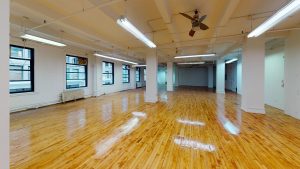
| Gallery district ground floor (Chelsea, Tribeca, SoHo side streets) | $90 to $200 | 2,000 to 8,000 SF | The classic gallery box. Loft ceilings, a real entrance, freight access, usually a cellar. Where most serious programs end up. |
| Emerging district ground floor (LES, Two Bridges, Downtown) | $50 to $150 | 500 to 2,500 SF | A storefront you can afford. Smaller, lower ceilings, less wall to work with. |
| Upper floor, gallery building | $50 to $110 | 1,500 to 6,000 SF | Column-free loft floors, better light, a fraction of the ground floor rent. Costs you the street, so the program and the mailing list have to do the work. |
| Upper floor, prewar office tower (57th St, Midtown, Downtown) | $35 to $90 | 800 to 4,000 SF | Elevator building, staffed lobby, real security. Appointment-only and private dealer territory. |
| Cellar / lower level | About 40% to 60% of the ground floor rate | Varies | Storage, crating, viewing room, back of house. Worth real money in Tribeca, worth a lot less in the Chelsea flood zone. |
| Short-term & pop-up | Quoted by the week or month | 500 to 3,000 SF | A month for one show, or a fair week presence, without a five year commitment. Expensive per day and often worth it. |
Two things move your real cost more than the headline rent. First, whether the rent covers everything or just the base. Retail style leases often push taxes, insurance and maintenance on top, so ask what’s included and add it all up before you compare two spaces. Second, the build-out, which is never as cheap as bare white walls sound. Add proper lighting, a level floor and climate control and it gets expensive fast.
If the letter grades on a listing sheet mean nothing to you, what makes a New York City building Class A, B, or C sorts it out. Most gallery space sits in Class B and C loft buildings, and that’s a good thing.
One decision saves or costs more money than any other in a gallery search, and it isn’t the neighborhood. It’s the floor.
Ground floor is the number everybody quotes, because it’s the space people can see and walk into. Upper floors in the same building usually run 25% to 50% of that. On 4,000 square feet in Chelsea, moving from the ground floor to the third can be the difference between $600,000 a year and $260,000.
So the question is whether walk-in traffic sells your work. If you’re an emerging program that lives on discovery, foot traffic is oxygen and you should pay for it. If your clients come by appointment and your real sales floor is a fair booth in September, the street is an expensive amenity. Plenty of excellent galleries operate on the fourth floor and do fine.
Below grade space usually prices around 40% to 60% of the ground floor rate, and for a gallery it isn’t dead footage. That’s your storage, your crating room, your private viewing room and your office. Ask any dealer who moved to Tribeca and the cellars were half the reason, because Tribeca sits far enough east that the lower levels are out of the flood zone and insurable for art. A lot of Chelsea’s below grade space got reclassified after Sandy, and insuring work down there is a different conversation.
Landlords love quoting one blended number across ground, cellar and mezzanine so the space sounds cheaper per foot than the ground floor is. Don’t let them. You’re paying premium money for the part visitors walk into, and you should know exactly how much.
| Floor Position | Typical Share of Ground Floor Rent | What Galleries Use It For |
| Ground floor | 100% (the quoted number) | Main exhibition space and street presence |
| Cellar / lower level | About 40% to 60% | Storage, crating, viewing room, office, prep |
| Mezzanine | About 50% to 70% | Office, small works, viewing area, a second hang |
| Second floor and up | About 25% to 50% | Full exhibition space for appointment driven and destination programs |
Loft buildings are where this math works hardest in your favor, since the upper floors come column-free with the ceiling height and window line you wanted anyway. Commercial loft space for rent in New York City covers that stock.
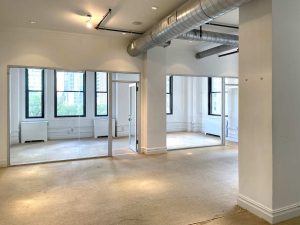
Square footage is the wrong first number. What you want to know is how much unbroken wall you have to hang on. A 3,000 square foot room chopped up by columns and windows can hold less work than a 2,000 square foot room with four clean walls, and dealers sign the wrong one all the time because the listing sheet made it look bigger.
Walk every space with a tape measure, a contractor and the dimensions of the biggest piece you expect to show. Then run this list.
| What to Check | Why It Matters | What to Ask or Verify |
| Unbroken wall | This is your real capacity. Windows, doors, columns and radiators all eat wall. | Measure the uninterrupted runs, then count how many works of your typical size fit on each one. |
| Ceiling height | Ten feet is the practical floor. Twelve to sixteen is what makes a room feel like a gallery and lets you show scale. | Measure to the lowest obstruction, not the deck. Sprinklers, ducts and lights set your real ceiling. |
| Columns and clear span | A column in the wrong spot kills your sightlines and your install plan for the whole lease. | Get a floor plan with column locations and dimensions before you fall for a photo. |
| Floor load | Sculpture, installation and dense crates can blow past what an old loft floor is rated to carry. | Ask for the live load rating in pounds per square foot, in writing, and have an engineer confirm it for anything heavy. |
| Freight and loading | If a crate can’t get in the door, nothing else on this list matters. | Measure the freight cab, the door openings, the corridor turns and the loading dock or curb cut. Confirm freight hours. |
| Lighting and electrical | Track lighting pulls real power and an old panel won’t carry a proper install. | Check panel capacity and open circuits. Budget for track, dimming and a lighting designer. |
| Climate control | Works on paper, photographs and anything on canvas need stable temperature and humidity, not just a working AC unit. | Ask how old the HVAC is, who pays to fix and replace it, and whether it holds humidity or only temperature. |
| Light control | Great natural light sells a space and damages the work. You need both, on command. | Confirm you can install shades, film or blackout without tripping a landmark facade rule. |
| Security | Your inventory is worth more than the building’s and the landlord’s system wasn’t built for that. | Plan on your own alarm, cameras and access control. Confirm what you’re allowed to install and who holds keys. |
| Storage and back of house | Racking, crates, packing materials and somewhere to work on art out of public view. | Look for a usable cellar or a dedicated back room. Off-site storage is a recurring cost first-timers forget. |
| Water above your head | Bathrooms, kitchens and risers on the floor above are how art gets destroyed in New York. | Find out what’s directly overhead and get a leak and water damage provision into the lease. |
| ADA access | Your entrance, path of travel and restroom have to be accessible, and fixing a non-compliant space lands on you. | Check for steps at the entry, door widths and restroom compliance before you sign. |
Three of those deserve more attention than they get. Freight, because a beautiful room you can’t get work into is an expensive storage unit. Floor load, because nobody thinks about it until an engineer says no three weeks before an install. And water above your head, because that’s the most common way a New York gallery loses inventory.
Every other gallery space page on the internet skips this part, and it’s the part that costs people money. A gallery isn’t automatically a legal use in the space you just fell in love with, and the rules changed recently enough that plenty of brokers haven’t caught up.
As of June 6, 2024, the City of Yes zoning amendments reorganized New York’s Use Groups from numbers into Roman numerals and reshuffled what goes where. Commercial art galleries came out of the old retail bucket, Use Group 6C, and landed in Use Group VIII: Recreation, Entertainment and Assembly Spaces. You’re grouped with places of assembly now, not the shoe store next door.
Already open and operating? Relax. Existing uses aren’t treated as a change of use, so nothing about your gallery suddenly became illegal. But every new building and C of O alteration filed since July 1, 2024 uses the new groups, and the classification starts mattering the moment you convert a former retail space into a gallery, or the building’s C of O says one thing and your plans say another. Get your architect checking the City Planning translation tables early. Not after you sign.
Pull the building’s C of O and see what the floor you want is certified for. Wrong use on the certificate means either a long uncertain approval or a dead deal, and that timeline isn’t yours to control. It gets worse in residential zoning districts, where galleries have historically needed a special permit from the City Planning Commission to operate at all. That’s a year plus. Touring a townhouse floor on the Upper East Side? This is your problem.
The SoHo-Cast Iron Historic District, Tribeca West and Tribeca South, the Upper East Side Historic District, the Special Madison Avenue Preservation District. Between them they cover a huge share of the buildings galleries want. Good news is stability, since nobody’s knocking your building down or converting it out from under you. Bad news is signage, storefront changes, window treatments and anything else touching the facade, all of which need Landmarks approval. Build that timeline into your opening date, because it will not move for you.
Every gallery in New York throws openings, and openings are exactly what the city regulates. The Department of Buildings requires a Place of Assembly Certificate of Operation any time 75 or more people can gather indoors, plus an FDNY permit on top of it that gets renewed after inspection each year.
The part that trips people up is how that 75 gets counted. It comes from your square footage and use classification under the Building Code, not from how many invitations go out. A 3,000 square foot gallery can carry an occupant load well past 75 whether or not anybody shows. So during diligence, find out whether the space already has an active Place of Assembly certificate, what number it covers, and what it would take to get one or amend it. Running a packed opening without it is a violation, and it’s the kind somebody notices on a Thursday night in Chelsea.
While you’re at it, deal with the wine. Serving alcohol at an opening generally means a temporary permit from the State Liquor Authority, and both the building and your lease have to allow it.
Zoning and permitting summary as of July 2026, from the NYC Zoning Resolution as amended June 6, 2024, the DOB service notice on Use Group changes (June 20, 2024), and DOB Place of Assembly requirements. General orientation, not legal advice. Confirm your specific space with an expediter, an architect and a real estate attorney before signing.
Gallery leases follow retail rules, not office rules, and that catches people off guard. Short version: expect to take the space as-is, expect free rent instead of construction money, and expect to personally guarantee something.
Office landlords hand out construction allowances. Retail landlords mostly don’t, and the people leasing gallery space behave like retail landlords. What you get instead is free rent. Months of it, sometimes a lot of it, so you have runway to build and open before rent starts. Established galleries with real credit can still negotiate an allowance, so ask. But plan around free rent as the currency, and fight for the number of months as hard as you fight over the rent itself.
And a gallery build-out sounds simpler than it is. Walls that are flat and plumb. A floor level enough to hang against. Track lighting on circuits that can carry it. Climate control that holds humidity. A secure back room. Often a new storefront and entry. Understanding build-out agreements and who pays for the build-out, you or the landlord get into how that work gets scoped, funded and argued over.
Most gallery leases run five to ten years, with ground floor flagship deals stretching to ten or fifteen. A longer term buys better economics and a landlord more willing to chip in, but it also chains you to a district that might look completely different in a decade. Ask anybody who signed a fifteen year Chelsea lease in 2011. 3-year, 5-year and 10-year lease terms lays out the tradeoff.
Whatever you sign, negotiate the exit on the way in. Your right to assign or sublease is the escape hatch, and it’s far easier to get at signing than to beg for later. Same with renewal options, so a landlord can’t hold a location you spent ten years building hostage at renewal.
When you get to the lease itself, three guides do the heavy lifting: key terms to include in a lease offer, the lease clauses that quietly decide your cost, and the essentials to ask before you sign.
A gallery search takes longer than an office search, because the inventory that works is small and the diligence is heavier. Give yourself nine to twelve months from first tour to opening night if you’re building anything. This is the order it goes in.
Not ready to commit for a decade? Two other roads worth walking. A sublease can put you in a built-out space well under market on a shorter term, though you inherit whatever deal the original tenant cut and however much time is left on it. And short-term or pop-up space, priced by the month, lets you test a district or run one show without betting the business on it. Outgrowing a shared arrangement? The same logic runs through scaling up into your own space.
Gallery real estate in New York concentrates in a surprisingly small number of buildings and blocks, and knowing which ones matters more than it should. A multi-tenant gallery building hands you foot traffic you didn’t have to generate, neighbors who send people down the hall, freight that was built for this, and a landlord who already understands why you need Thursday nights.
| Building or Cluster | District | The Read |
| 508 to 534 West 26th Street (the West Chelsea Building) | Chelsea | The biggest concentration of artist studios and galleries under one roof in the city, roughly 400,000 SF. Listed for sale at $170 million in December 2024 after the owner died, with tenants organizing over what happens next. Watch this one. |
| The West 20s gallery blocks (W 20th to W 27th, Tenth to Eleventh) | Chelsea | Purpose-built and converted gallery buildings stacked three and four programs deep. The megas own their flagships here. Ground floors carry the volume, upper floors carry the value. |
| 55 Walker Street | Tribeca | One address housing several respected midsize programs, which is the whole Tribeca model in miniature: shared building, shared traffic, independent programs. |
| Cortlandt Alley & White Street | Tribeca | The densest walkable stretch in the district. Loft floors, cast iron frontage, usable cellars, and enough neighbors that visitors make a night of it. |
| Henry, Orchard & Grand Street storefronts | Lower East Side | Small ground floor rooms in tenement stock, the traditional way people open a first gallery. Cheapest street presence in Manhattan, with the lowest ceilings to match. |
| Upper Wooster, Greene & Prince floors | SoHo | Cast iron loft floors above the fashion retail, with the best natural light in the city. You give up the street and pay a fraction of the ground floor number. |
| Madison and the side streets, 60s to 80s | Upper East Side | Townhouse floors and small elegant rooms near the collectors and the auction houses. Seventeen retail and restaurant openings on Madison in the first half of 2026, a new Gagosian among them. |
| The 57th Street prewar towers | Midtown | Long-tenured dealers in elevator buildings with staffed lobbies and real security, a short walk from MoMA and the salerooms. Appointment driven, almost entirely upstairs. |
Ground floor space in the main gallery districts generally runs $90 to $200 per square foot a year. Prime Madison Avenue and SoHo Broadway frontage climbs past $200 and can hit $500, while emerging blocks on the Lower East Side and Downtown start closer to $50. Upper floors in the same buildings usually run 25% to 50% of the ground floor rate, which is why so many good galleries operate above the street. Your real cost also depends on whether the lease passes through taxes and insurance, and how much free rent you negotiate.
Depends on your program. Chelsea still has the most blue chip square footage and the biggest rooms. Tribeca has been the center of gravity for midsize contemporary galleries since 2020, with landmarked loft stock and cellars you can use. The Lower East Side is where emerging programs start, the Upper East Side and Madison Avenue serve the secondary and modern market, and Downtown is the best value if you’re willing to build the destination yourself.
Ten feet is the practical floor. Twelve to sixteen is what makes a space read as a gallery and lets you show work at scale. Measure to the lowest obstruction rather than the deck, because sprinkler heads, ducts and light fixtures set your real hanging height. And remember that unbroken wall matters more than either ceiling height or square footage, since windows, doors and columns all eat the wall you hang on.
Possibly. As of the June 6, 2024 zoning amendments, commercial art galleries fall under Use Group VIII, Recreation, Entertainment and Assembly Spaces, rather than the old retail Use Group 6C. The building’s Certificate of Occupancy has to permit that use for the floor you’re taking, and galleries in residential zoning districts have historically needed a special permit, which is a long process. Pull the C of O and check the zoning district before you sign anything.
If 75 or more people can gather indoors, yes. New York requires a Place of Assembly Certificate of Operation from the Department of Buildings plus an FDNY permit that renews every year after inspection. The catch is that the 75 gets counted from square footage and use under the Building Code, not from your guest list, so the requirement can attach to a mid-sized gallery whether or not anybody shows up. Find out during diligence whether an active certificate exists and what number it covers.
Usually not, or at least not all of it. Gallery deals follow retail rules, which means the space comes as-is and the concession shows up as free rent instead of a construction allowance. Established galleries with strong financials can sometimes negotiate a contribution, so it’s always worth asking, but budget on the assumption that walls, lighting, flooring and climate control are yours to fund.
Five to ten years is typical, with ground floor flagship space often running ten to fifteen. A longer term usually buys better economics and a more generous landlord, but it also locks you into a district that can change character fast, which is what happened to galleries that signed long Chelsea leases before Hudson Yards went up. Negotiate renewal options and your right to sublease or assign at signing, not later.
Two separate things. Your lease will require commercial general liability coverage, which protects the landlord and the building and does nothing for the art. Separately you need a fine art or property policy covering work on the wall, in storage and in transit. Be specific with your broker about consigned work, because coverage for property you don’t own is its own conversation.
Only if walk-in traffic sells your work. For an emerging program that lives on discovery, street presence is worth paying for. For a secondary market or appointment-only dealer whose clients schedule visits and whose real sales floor is an art fair booth, the ground floor is an expensive amenity and the same money buys a much better room upstairs. Be honest about which one you are.
Costs you nothing, because the landlord pays the commission. The better reason to use one is that most gallery space never gets publicly marketed. It moves between dealers, through owners who already lease to galleries, and through brokers who walk these blocks. A tenant broker also knows which landlords are comfortable with openings, freight and after-hours access, and no listing sheet will ever tell you that. Metro Manhattan has been representing tenants in this market since 2004.













Accessibility Tools